Saturday, February 15, 2025

"Mt. Belvedere - 80 Years On"


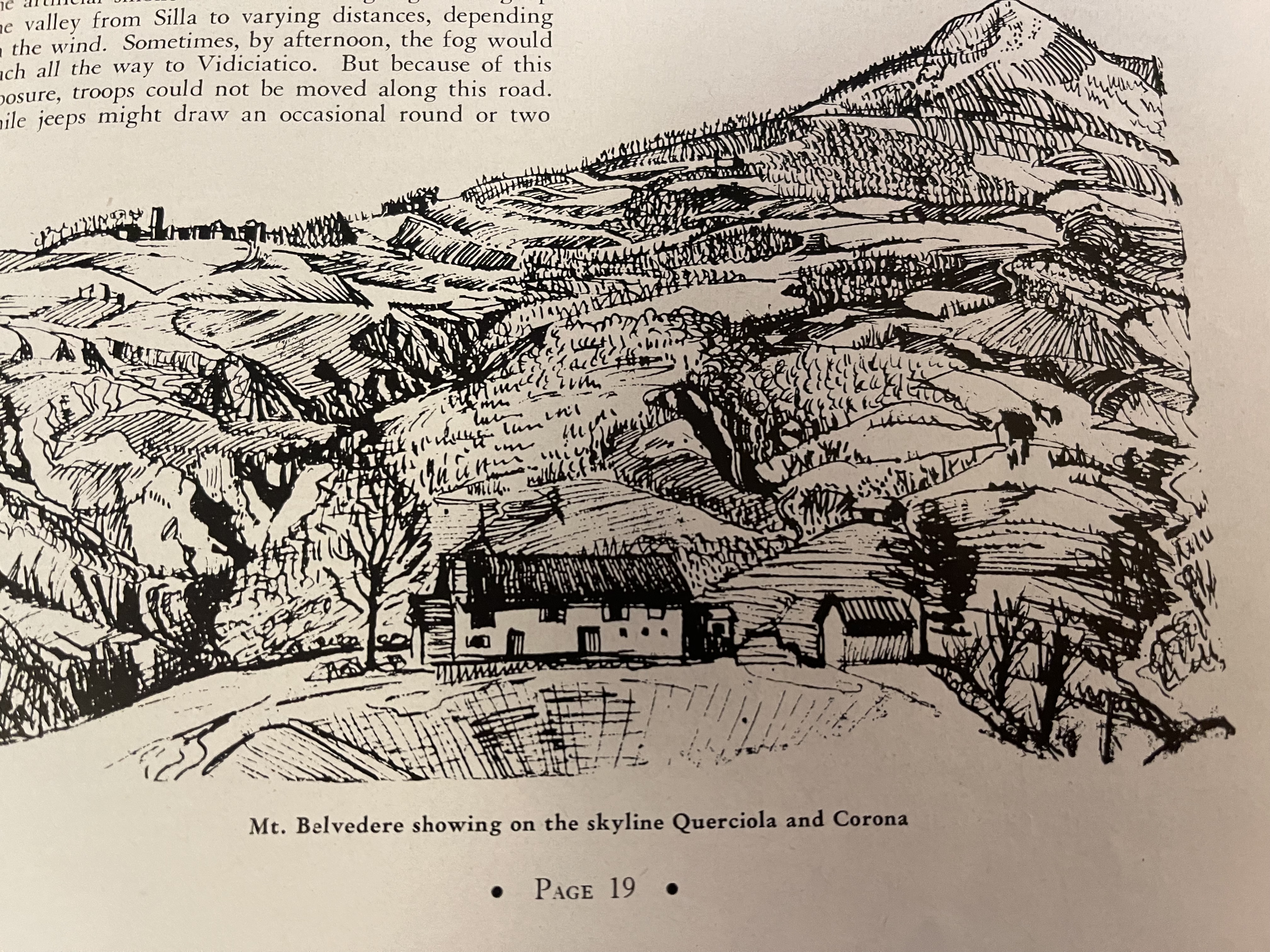


This coming Wednesday will mark 80 years since the Ski Troops, the 10th Mountain Division, first saw action in Italy. My father was part of the assault on Mt. Belvedere in Italy’s Apennines.


Attached are three photos: the first a sketch of Mt. Belvedere that was drawn by Captain George F. Earle; it appeared in his History of the 87th Mountain Infantry, Italy 1945, published 20 October, 1945. The second and third are of a scene on top of Belvedere at the end of the first day and a caption for the photo. The last two items appear in an April 1946 album put together by 2nd Lt. Richard A. Rocker, also of the 87th, titled Vires Montesque Vincimus translated as “We Conquer Powers and Mountains,” the insignia for the 87th Regiment – my father’s regiment – of the 10thMountain Division. 


……………………………………………………………………………….


The passage of time can be deceptive. It is hard to imagine, at least for me, that the 80 years between now and the end World War II are equal to the 80 years from the end of the Civil War to the end of World War II.


Enjoy the long weekend, but don’t forget those who served.


Sydney M. Williams


More Essays from Essex

“Mt. Belvedere – 80 Years On”

February 15, 2025


“It is the duty of every generation to remember the sacrifices

of those who came before, so that their legacy may live on.”

                                                                                                                                Herman Wouk (1915-1919)

                                                                                                                                War and Remembrance, 1978


With the 80th anniversary marking the end of World War II fast approaching, the number of combatants still alive is shrinking. The Bureau of Veteran Affairs estimated last year that, out of over 16 million Americans who served in the War, approximately 66,000 men and women are still with us, with an estimated 55 dying each day. As well, we are rapidly losing even those with memories of the War.


So it is fitting to mark battles in which members of our families participated. By early January 1945, the ultimate outcome of the War was obvious, yet an estimated 49,000 American GIs were yet to die in combat. Okinawa, Iwo Jima and the Battle of Berlin were yet to be fought. Among the lesser well-known battles was one that took place in Italy, where an estimated 100,000 German troops under General Albert Kesselring were embedded along what was called the Gothic Line, a roughly 200-mile defensive line running along the Apennines from Spezia on the Ligurian Sea to Pesaro and Ravenna on the Adriatic. Following the fall of Rome in early June 1944, Germans retreated north to this mountainous defensive position that protected the farm-rich Po Valley and the cities of Bologna and Verona. The key was Mount Belvedere, the highest peak, which overlooked Highway 65, the main road between Florence and Bologna.   


In March 1944 my father, then thirty-three, married and father of three (with a fourth on the way), was drafted. After basic training at Fort McClellan in Alabama, he transferred to the 10th Mountain Division – the “Ski Troops,” who had trained in Colorado, but were then stationed at Camp Swift, about 40 miles east of Austin. In December, the 10th was sent to Fort Patrick Henry in Virginia, prior to being shipped to Italy later that month. A full complement of 14,000 men, under Major General George P. Hays, were sent to rout Kesselring’s troops from their mountainous redoubts. In Mountain Troopers, Curtis Casewit quoted General Hayes: “Mt. Belvedere must be captured before we can advance.”


In November 1944, elements of the British 8th Army and the U.S. 5th Army had attacked Germans entrenched on Belvedere. German counter-attacks caused them to retreat. Three months later, on February 19th, the 10th Mountain Division (now part of the 5thArmy) made its ascent, beginning at 0030 hours. The night before the 1st Battalion of the 86th Regiment captured Riva Ridge, which overlooked slopes on Belvedere. Along with others, C Company (my father’s unit) of the 87th Regiment were ordered to move silently forward, with Division artillery supporting the attack. They walked single-file, ten feet apart. “The way up,” Peter Shelton wrote in Climb to Conquer, “was long and folded, riddled with streams and ditches, with sharp ravines and bombed-out wagon roads.” They had to avoid mined fields and went past “ghostly remains of U.S. tanks,” abandoned on that earlier attempt. Because of walking past German sentries, the GIs, with fixed bayonets, carried grenades but no live ammunition – at least until daylight. Unfortunately, several soldiers were killed by mines. By 0430 Company C had attained its objective atop Belvedere, but with three of its men killed. Hays was again quoted by Curtis Casewit: “Mt. Belvedere and the occupied ground will be held at all costs.”


My father, a Harvard-educated artist, was not insensitive to the horrors of battle and the casualties around him when he wrote my mother on February 28 – the first time in almost two weeks that he had had a chance. He did not want to worry her more than she already was: “I’m behind the lines again after spending another week on the front. This time it wasn’t quite so comfortable, with foxholes and shells landing round about and that sort of thing. But the weather was nice and it wasn’t really too bad…I was in the attack on Mt. Belvedere, which is more like a hill than a mountain…There were crocuses in bloom on Mt. Belvedere and the view was beautiful, both day and night, a strange setting for a battle.”[1]


German counter-attacks continued for five days; among those killed was a young member of my father’s platoon, 18-year-old Juan Barrientos. He was killed by a shell fragment, a fragment that nicked my father’s cheek. They would have nine more weeks of combat before the war in Italy was over on May 2. Just under 1,000 ski troops would be killed, with almost 4,000 wounded – one of the heaviest casualty rates of any division based on time in action. Among those wounded was Senator Robert Dole, a replacement officer, on April 14 in Castel d’Aiano. My father, who became a runner for his company, was among the lucky ones. He was awarded the Bronze Star for “meritorious service.” His homecoming, at the Nashua, New Hampshire railroad station on V-J Day, remains vivid in my mind. Among the cheers, tears, joy, and honking of horns, I recall running across the parking lot to greet him. 


“Freedom is not free,” may sound trite; nevertheless, it is a truism. Over the almost two hundred and fifty years of our nation’s existence, millions of men and women have given up years of their lives in defense of their country, and many paid the ultimate sacrifice, that the rest of us may live in peace. In his book quoted above, Herman Wouk wrote: “The scars of war may fade, but they will always be a reminder of the price we paid for peace.”


2025 marks eighty years since the end of the greatest war the planet has ever seen. We should spend a few minutes thinking of those who sacrificed that we might enjoy that precious gift of freedom.


[1] Dear Mary: Letters Home from the 10th Mountain Division, 2019, page 61, edited by Sydney M. Williams

Labels: , , , , , , , , , ,

Sunday, November 3, 2019

"The Winter Army," by Maurice Isserman


Sydney M. Williams
www.burrowingintobooks.blogspot.com

Burrowing into Books
“The Winter Army” by Maurice Isserman
October 21, 2019

General Hays…his division had been my most dangerous opponent.”
                                                                                    General Fridolin von Senger und Etterlin
                                                                                    Commander, German IV Panzer Corps
                                                                                    May 3, 1945
                                                                                    As quoted in The Winter Army

The quote above from German General von Senger und Etterlin, in referring to General George P. Hays, commander of the 10th Mountain Division, tells of the Division’s fighting spirit and capabilities. The German General was an experienced officer. He had fought in the Battle for France in 1940 and had led troops in the battle for Monte Casino during the winter and spring of 1944. His respect for the men of the 10th Mountain Division speaks volumes.

In preparation for my book Dear Mary, I read more than a dozen histories of the 10th Mountain Division, including the wartime, day-by-day story of the 87th (my father’s Regiment) compiled by Captain George Earle and published in October 1945. Apart from the details available in Captain Earle’s book, The Winter Army by Maurice Isserman is the best book I have read about this elite mountain group. He takes the reader from the genesis of the 10th, when four men including C. Minot (Minnie) Dole talked of the need for ski troops over drinks before a roaring fire at Manchester, Vermont’s Orvis Inn in February 1940, to War’s end in Italy on May 2, 1945, with the victorious 10th Mountain Division on the shores of Lake Garda.

Professor Isserman writes of how the idea of a “Ski Troops” was born out of the Finnish resistance to the Soviet invasion of their country during the winter of 1939-1940. He tells of how it was Minnie Dole’s energy and persistence that convinced General George Marshall to support the idea, and of how the first troops trained at Fort Lewis in Washington and on nearby Mount Rainier. In early 1943 they moved to the newly constructed Camp Hale in the Colorado Rockies. The Army Post sat at 9,200 feet, surrounded by several 14,000-foot peaks. While the mountains and altitude were perfect for training mountain troops, conditions were awful because the valley trapped coal smoke, from the three engines required to bring men and supplies up from Denver and from the coal stoves used to heat the barracks. Nevertheless, they persevered. He writes of their training and of the disastrous (and unnecessary) invasion of Kiska in early June 1943, an island in the Aleutians, which had been occupied and then abandoned by the Japanese.

We learn that a year later, in early summer 1944, the Ski Troops, now re-christened the 10th Mountain Division, was moved to Camp Swift in Texas in preparation for overseas deployment. (It was in Texas where my father joined the 10th.) In December and January, on two ships, the three regiments sailed from Fort Patrick Henry in Newport News, Virginia to Naples, Italy. From there they went up the coast to Livorno and then east to Pistoia and then north into the Northern Apennines, where on February 18 and 19 they attacked, first Riva Ridge and then Mount Belvedere. Maurice Isserman writes that after the battle “Belvedere was a mountain of death, littered with the bodies of American and German fighters.

Isserman makes use of letters, diaries and newspapers, including the “Blizzard,” the newspaper of the 10th. But it is diaries and letters that are most revealing. Following the attack on Belvedere, he quotes from Private Robert Ellis’ diary: “…Counterattack surrounded us. Prayed in my foxhole and read my Bible. Shrapnel dropped on my stomach. Can’t take it any longer.” While letters were subject to censorship, there is poignancy in some of them. In a letter home, three days after the Germans surrender, Wallace Arnheiter, of the 85th Regiment, is quoted: “We are all just coming out of the fog now – for the last  month we’ve been ‘sweating it out’ – just praying it would end before the law of averages caught up with us. So many of my buddies died and so many more were hurt…You wonder why God let you walk through all that hell, and come out unscratched, and took so many finer, better men.” In all, over 900 men from the 10th were killed and over 4,000 wounded during the two and a half months the Division was in combat.

Much of the fighting and most of the casualties occurred during the spring offensive that began in mid-April 1945, when the outcome of the War was no longer in doubt – the Soviets had crossed the Oder by the end of January and the Americans and British had crossed the Rhine by the end of March. Professor Isserman notes the motto of the 10th, Sempre Avanti, and wonders, “…had the time arrived in Italy when always forward ceased to make sense?” The question is rhetorical, but one asked by those whose loved ones died in the waning weeks of the war. However, it is impossible, from a perspective of seventy-five years, to place ourselves in the position of those then in command. They did not have the benefit we have of knowing their future.

Isserman concludes his story by telling the reader of how wartime skills were used to create a civilian pastime – recreational skiing. Veterans of the 10th could be found in years afterwards on ski slopes in Colorado, the Cascades, the Sierras and in the Green and White Mountains of Vermont and New Hampshire, transforming the sport of skiing “from an elite pastime to a mass participation sport.” As for Italy today, he writes: “The views today from Riva Ridge and Mount Belvedere are of a beautiful and peaceable landscape in an imperfect but better world. The men of the 10th helped make it so. Sempre Avanti.”

The Winter War is a valuable addition to the growing collection of books dealing with World War II, a war unlike anything the world had ever experienced and unlike anything the world will ever see again. According to the U.S. Department of Veteran Affairs, there were 496,777 of the 16 million who served in World War II still alive in 2018. With all of them in their nineties, there are considerably fewer today. We owe them honor and respect, and we owe them an understanding of the dangers they faced in defense of liberty. To listen, read and learn from their exploits is the least we can do.


Labels: , , , , , , , , ,

Monday, July 8, 2019

Book - "Dear Mary: Letters to and from Italy - January 1945-July 1945."

Sydney M. Williams

 This book is to be published in July 2019 and is available on Amazon or your favorite bookstore.

Introduction

“Dear Mary: Letters to and from Italy, January 1945 – July 1945”
                                                                                                                                      July 8, 2019

Please Mr. Postman, look and see.
Is there a letter, a letter for me?”
                                                                                    The Marvelettes
                                                                                    “Please Mr. Postman,” 1961

My father was drafted in March 1944. He was thirty-three years old, married with three children and a fourth on the way. After basic training at Fort McClellan in Alabama he was transferred to the 10thMountain Division, which was then stationed at Camp Swift in Texas. In December they were sent to Fort Patrick Henry in Virginia, and on January 4ththey boarded the USS West Point (built in 1940 as the SS America) for the trip to Naples, Italy. He was a PFC, in the 87thRegiment, 1stBattalion, C Company, 2ndPlatoon, 2ndSquad. In six years of marriage, my parents had not been separated. This is their correspondence during a trying time for the country, but especially for those who were sent overseas and for loved ones who remained at home.

In his new biography, Churchill: Walking with Destiny, Andrew Roberts writes of the future Prime Minister writing to his wife when he went to France in November 1915: “His letters,” Mr. Roberts writes, “allow us to peer into his mind better than at any other period in his life.” All letters do that, but especially those between spouses. Unlike Churchill’s my parents’ letters were never written with the prospect of being published. That was something to consider when weighing the appropriateness of having the letters transcribed and made available for all to read. In the end, their value as a window onto a special time in our history seemed worth whatever embarrassment might accrue to those no longer alive.

One could argue that letters between one man and one woman reflect only their thoughts and, thus, have little universal value. But their significance, in my opinion, is more ubiquitous. Sixteen million Americans served in uniform during the three years and eight months the United States was at war. More than a million became casualties. For every soldier serving, there were two or three (or more) family members at home. In all, they represented almost half of the United States’ population of 132.1 million in 1940. This was truly a total war.

For those who did remain at home, life was not easy, even excluding fears of the unknown. Lives were disrupted in many ways. There was a breakdown in in social values: Divorce rates increased, as did truancy, juvenile delinquency and venereal disease. Alcoholism was a problem. With women needed in the workforce, there was a growth in unsupervised, “latchkey” children. While unemployment declined due to conscription and expansion of war industries, so did safety nets, as spending on defense needs preempted funds for support programs, so poverty increased, and income gaps widened. Gasoline rationing meant restricted travel and food rationing meant substitutions, like powdered eggs and milk, and liquid paraffin for cooking oil. At one point during the war, 50% of the nation’s vegetables came from “Victory Gardens.”

As these letters show, my parents were more fortunate than many. My mother moved back to her parents in Madison, Connecticut, where we lived in idyllic conditions—a large house on Long Island Sound, a barn with animals and a mother and grandparents who were attentive and who loved us. We were too young to understand what was happening, and we were never deprived of food or a comfortable place to sleep. We were protected from the worries that consumed my mother and grandparents. My family was fortunate in other ways. All immediate family members survived. My mother’s three brothers served as Naval officers; all experienced combat and all returned uninjured. Of my father’s two brothers, one was a medical doctor who remained state-side, the other an Army Lieutenant who was wounded on Okinawa but made it home with no visible scars. Both my father’s brothers-in-law served as Naval officers; neither was wounded.

This generation was the last of the letter writers. My generation wrote letters when in school, college and the army, but we lived into an age of cell phones, e-mail, Instagram, Twitter and social media; so, the letters we write now are mostly ones of condolence or expressing thanks for a gift. But for those born earlier, the writing of letters was the most important means of communication.

Because of the personal nature of these letters, especially their reference to people and places, footnotes have been added where appropriate. The book also includes commentary about the War that allows the reader to follow the course of the 87thRegiment while in combat. Fortunately, there is a surfeit of literature about the 10thMountain Division, especially Hal Burton’s The Ski Troopsand Charles Hauptman’s Combat History of the 10thMountain Division. Particularly informative was History of the 87thRegimentby Captain George F. Earle, written in 1945, which includes a day-by-day history of their time in combat. It also includes a listing of all the men who served in the 87th. And, of course, the book of photographs, which have been used, with permission, to illustrate this book.

Besides letters to and from my parents, included are a few letters from my father’s parents, his two sisters and one of his two brothers.

Minor changes have been made to the letters. Paragraphs have been created where none existed. As well, commas and other punctuation marks have been added, to clarify what was written. While not all letters survived, a surprising number did—especially given that those from home were carried by my father in his backpack, across fields of battle. They traveled over the Apennines and through the Po Valley. They crossed the Po River, to the shores of Lake Garda (where they were when the War in Europe ended). The 10thremained in Italy, guarding the Yugoslav border against threatened incursions by Marshall Tito. They were there until the end of July, before sailing home from Naples. Since the expectation was that the Division would be sent to Japan for the planned invasion of Japan (Operation Downfall), included are letters written during those two and a half months after the war in Europe was over. All of these letters carry the voices of those who wrote them seventy-four years ago.

****************************

My father, a skier since the late 1920s, died in 1968 at the age of 58. He had grown up in Wellesley, Massachusetts and Peterborough, New Hampshire. He graduated from the Belmont Hill School in 1928 and left Harvard College, at the depths of the Depression in 1932, at the end of his senior year but without a degree. His love was art—he had drawn cartoons for the Harvard Lampoon—but jobs for cartoonists were scarce. He got a job as a receptionist in a brokerage firm, where he spent time carving pipes. Finally, he volunteered in the Entomology Department at Harvard, modeling backgrounds for display cases at the Fogg Museum. He did well enough that he was invited to join the Faculty Club, despite never having received a degree. In 1936, he resigned to study sculpture with George Demetrious at his studio in Gloucester, Mass., where he met his future wife, Mary Hotchkiss.

My mother, who died twenty-two years after my father, grew up in New Haven, Connecticut, in a large house at the top of Hillhouse Avenue, a house that belonged to her paternal grandfather. She graduated from the Foxcroft school in 1929 and spent a year in Italy at Madame Boni’s finishing school in Rome. Her life changed in 1933. Her grandfather had died in 1930. Her father, a director and vice president of U.S. Rubber Company in charge of their world-wide rubber plantations, had invested [sic] most of his money with Ivar Krueger, the Swedish “Match King,” a Ponzi-scheme operator whose empire toppled in 1933. The house on Hillhouse Avenue was sold. Their summer place in Madison became their year-round home. For two years my mother taught art at Foxcroft and, in the early summer of 1936, she went north to study sculpture with Mr. Demetrious, where she met my father. They were married two years later. At the time of their engagement, in October 1937, my mother wrote a revealing letter to her brother Henry about her fiancé: “His tastes are similar to mine, though perhaps he is more of the earth while I am off the earth, but his realm is comprehensive of both. He is an animal of instinct – does not bite, however – and stands for simplicity and nature.” They were married May 28, 1938 in New Haven.

*******************************

My mother spent most of that year and a half that he was in the Army with her parents in Madison, Connecticut. She brought with her three children and a fourth who would be born in August 1944. (I was the second oldest.) My earliest memories are of that period. I remember the house, the barn and the animals (which play a large part in these letters). I remember leaving my father at Union Station in New Haven in late August 1944, as he went off to Camp Swift in Texas, prior to being shipped overseas with the 87thRegiment of the 10thMountain Division, in early January 1945. He would be there until late July, before being shipped back to the U.S., ostensibly for a home leave before heading to the Pacific for the planned invasion of Japan. For me, those months were filled with the joy and wonder of childhood, a place where the guns and bombs that devastated Europe, the Middle East and Asia were not heard and had no meaning.

*******************************

My mother did not often display emotion, but there were tears in her eyes when I left for Fort Dix on August 11, 1962. The United States was not at war. I was fulfilling my military obligation, in serving six months of active duty. There was little chance I would be endangered. But for her, my leaving was a reminder of a time less than two decades in the past. It took me time to realize the emotions she must have felt. Time is long when one is young, but short, as one ages. It had been only seventeen years since my father had returned from Europe on VJ Day. Memories of those years must have haunted her, as it did millions of others. During the War, people like her lived in a cocoon, absent of information—until the next letter arrived, a letter censored to remove any information as to exactly where the writer might be, or what casualties his unit may have suffered. Battles would be reported by the press, but families did not know where their loved ones were or how they had fared—if they had been wounded or killed; there were no cell phones, e-mail or instant-messaging. What no wife, mother or child wanted was a telegram or, worse, a visit from the military.

*****************************

The lives of those left at home was surreal, like an Ingmar Berman movie, with past memories appearing in mist-like conditions and with vague glimpses of a what the future might hold. A few years after my mother died, I had a chance to read through the letters my parents had written one another. My mother’s letters provided a sense of the sacrifice she made, the gaiety she showed us children, the normalcy she expressed to my father and the torment that rendered her heart, which she was unable to disguise. It was not politics or the War as a whole that consumed her; it was the personal. In an appendix to War and Peace, Leo Tolstoy wrote of the contrast between the way historians view war and artists: “…for the artist there cannot and should not be any heroes, but there should be people.” These letters show people. Footnotes have been added to provide context, to explain, for example where his regiment was and had been, and to provide color regarding people mentioned. Unlike many returning soldiers, my father did speak of some of his experiences, but he always omitted the horror and fear he had to have experienced and felt.

None of these letters say anything about the geo-politics of the time, but they do show people, as individuals – not made-up and not idealized. This book is an attempt to derive a better understanding of that time and what life was like, for those in combat and for those left at home.


Labels: , , ,